
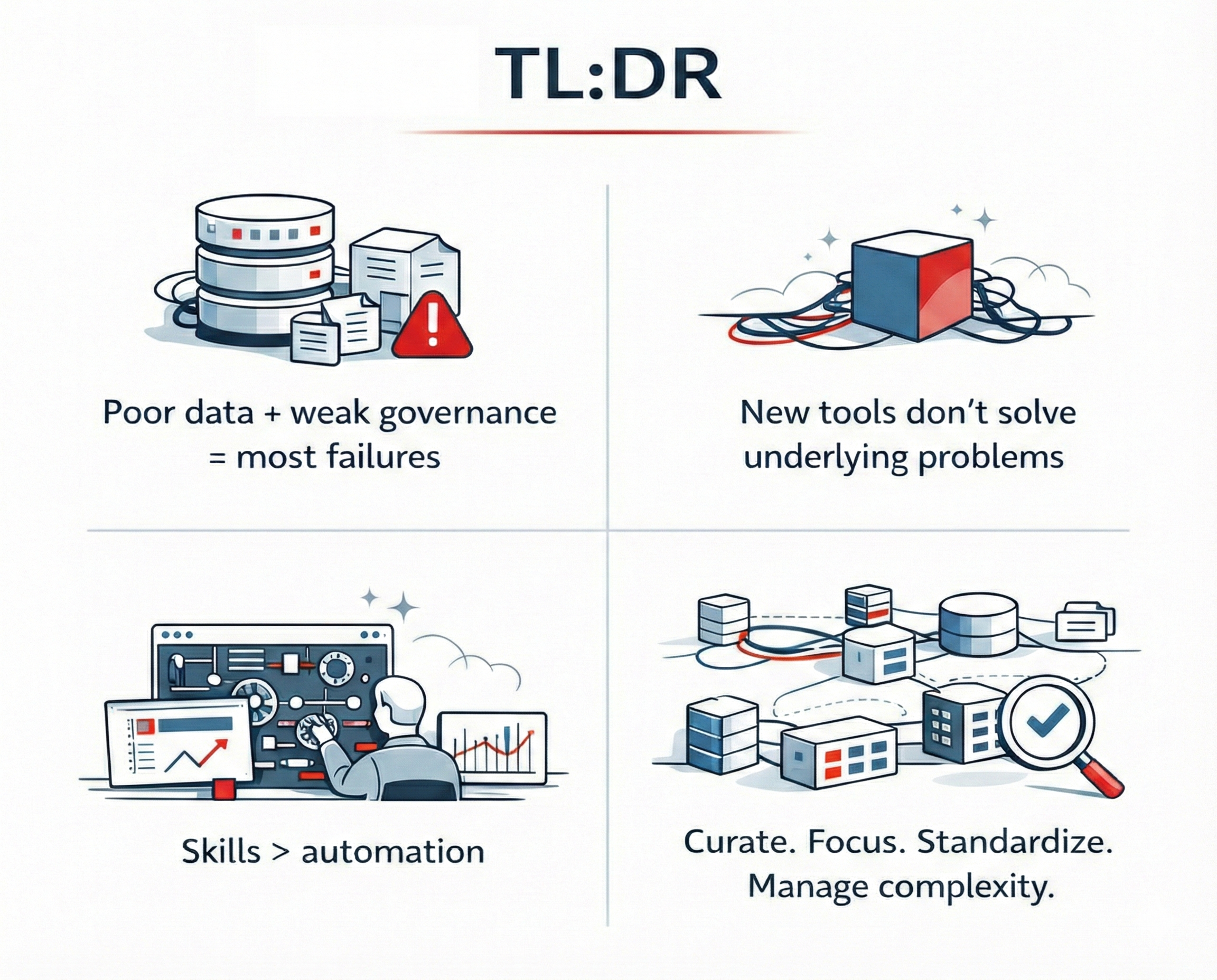
I’ve spent two decades wrangling enterprise marketing technology.
Loyalty systems, campaign platforms, data warehouses, you name it.
After a while, you start to see a pattern. The problems almost never come from the tech.
They come from the same handful of issues, popping up over and over across different companies, industries, and platforms. This is true even (maybe especially) in the case of global brands, with large, siloed marketing and database teams.
Before you touch another piece of your martech stack, here are a few lessons worth considering.
1. The Data is The Problem
When something isn’t working, the instinct is to blame the platform.
But more often than not, the real issue is data quality, access, or even knowing what the data actually means.
This happens everywhere. Different systems use different keys. Fields are coded differently. Important attributes live in some dusty corner of the organization. One department is the keeper of all the data for a particular program, and its people never seem to be available.
All it takes is one missing or unreliable field, and suddenly the whole campaign logic starts to wobble.
So many companies embark on ambitious “let’s centralize everything” initiatives.
They pull data from everywhere:
- CRM
- Loyalty
- Order systems
- Reservations
- Analytics
- Or, worst of all, spreadsheets that someone has been maintaining for five years
And then they drop it all into a central repository.
The problem?
They never get around to standardizing it, documenting it, or giving it business meaning.
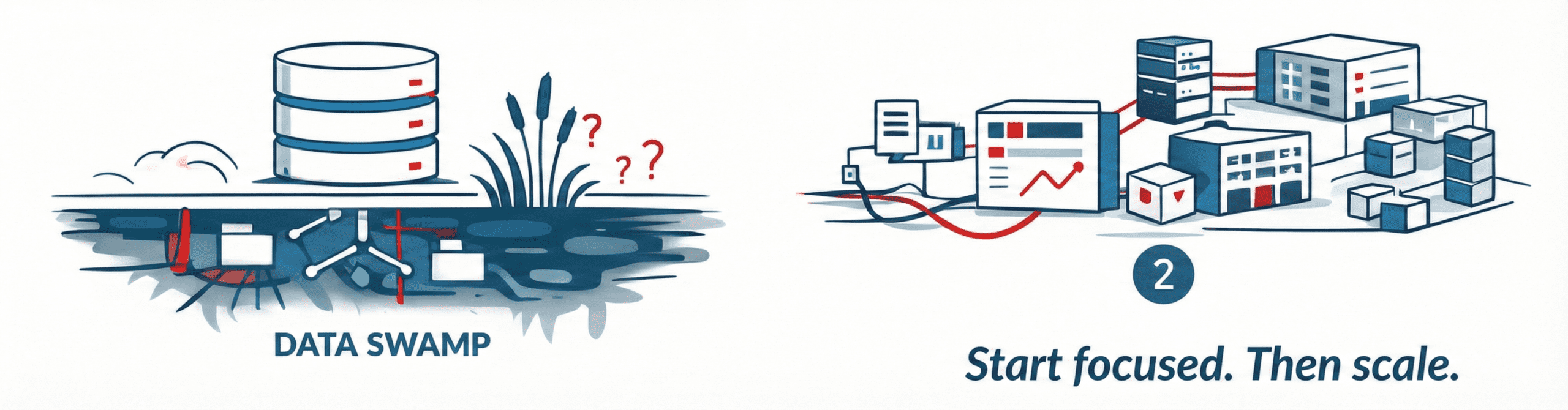
What you end up with isn’t a clean data lake; it’s a deluge of all the data the organization has been collecting for years. Data lakes quickly become swamps —huge, murky, and hard to navigate.
Then it gets worse. People avoid the swamp and start making their own unofficial workarounds, or what I call hidden data factories.
Imagine a marketing analyst who feels IT isn’t responsive enough to their requests. They start maintaining a duplicate suppression table, then track opt-outs in a personal dataset. Eventually, they decide to keep a “gold customers” list outside the official system… You know the one, labeled “DON’T EDIT THIS – ASK STEVE FIRST”
These stopgap solutions solve immediate problems. But over time, they pile up, creating brittle, hard-to-understand logic.
When your team doesn’t know where the “real” data comes from, your systems will eventually break. Here’s how:
- Someone solves a problem once.
- Others copy that logic into their campaigns.
- Nobody really understands how it works.
- The structure or logic changes of the source data
- Everything quietly starts breaking.
The real solution to the data problem is to have a layer between source systems and marketing tools. It’s like a surge protector to handle data changes and prevent swamps, factories, and random breakage.
2. New Platforms Don’t Solve Data Problems
Over and over again, I’ve seen companies tackle the data problem by migrating to a new platform. I just have a word of caution here: If you don’t have a handle on your data governance, a new platform is not going to stop the mayhem.
But if you’re going to upgrade to a new platform, and you need outside help, you should always remember this:
3. The Safe Choice Isn’t Always the Right Choice
If you choose a big-name vendor or consulting firm, you probably won’t get fired—even if the outcome is mediocre.
So decisions get made based on perceived safety:
- Big brand platforms
- Big consulting firms
- Big price tags
Not necessarily based on the best fit. As Adobe and Salesforce become increasingly bloated and expensive, we’re seeing large companies taking a long, hard look at new martech platforms built without the 20- and 30-year tech debt that underpins industry leaders. These are often worth a look.
Regardless, you need to understand that:
4. Tools Don’t Replace Talent
There’s a persistent belief that a simpler interface, more automation, or a “wizard-driven” system will reduce the need for skilled operators.
In reality, complex marketing problems still require experienced people. That’s because a simple interface just hides the complexity—it doesn’t remove it. You still need smart, talented people who understand the business and what makes your customers tick. Your people will still need to:
- Understand the data and how it fits into your business
- Have a clear view of the customer perspective
- Validate campaign logic
- And know when something doesn’t look right.
Nurture your talent and plan to keep them engaged, even if the platform people tell you that interns or AI will do their jobs.
And if you’re deadset on a new platform or major functional upgrades, you must:
5. Document Your Requirements, or Else
When large martech projects fail, the vendor usually gets blamed.
But the root cause often shows up much earlier.
Many companies:
- Don’t clearly define must-have requirements
- Don’t score platforms objectively
- Choose based on brand reputation or sales promises
Two years later and millions of dollars later, they found the platform couldn’t do what they actually needed. Sometimes the process has been so convoluted that they can’t articulate why they chose a new platform. If you fine-tune your vendor evaluation process, you’ll always achieve better outcomes.
And, as you implement new technology, you need to:
6. Focus on Prototypes, Not Perfection
When launching a martech initiative, organizations often try to:
- Integrate every data source
- Support every use case
- Build the perfect architecture
- All at once
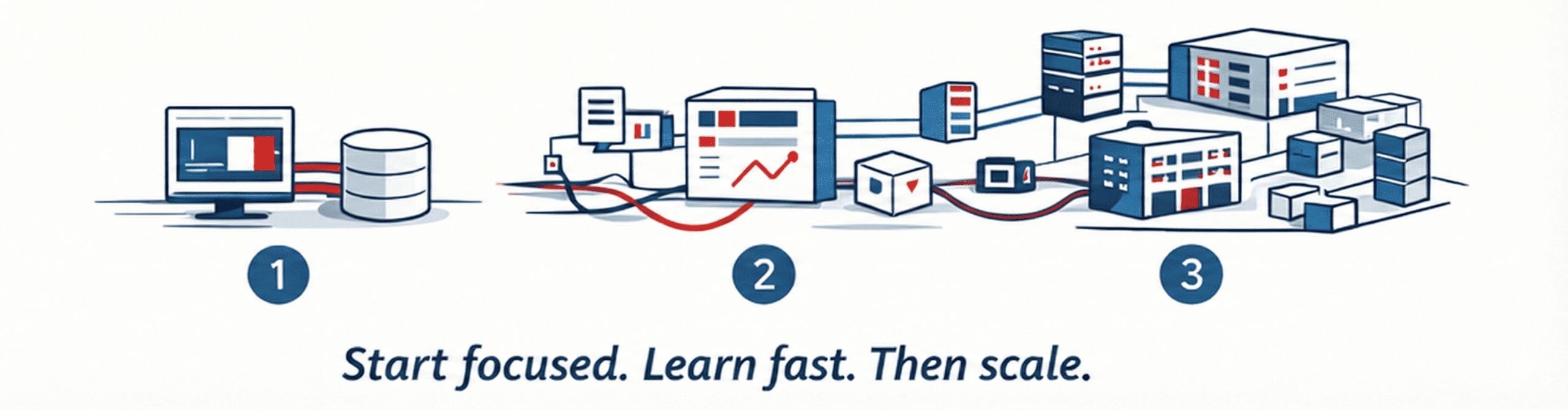
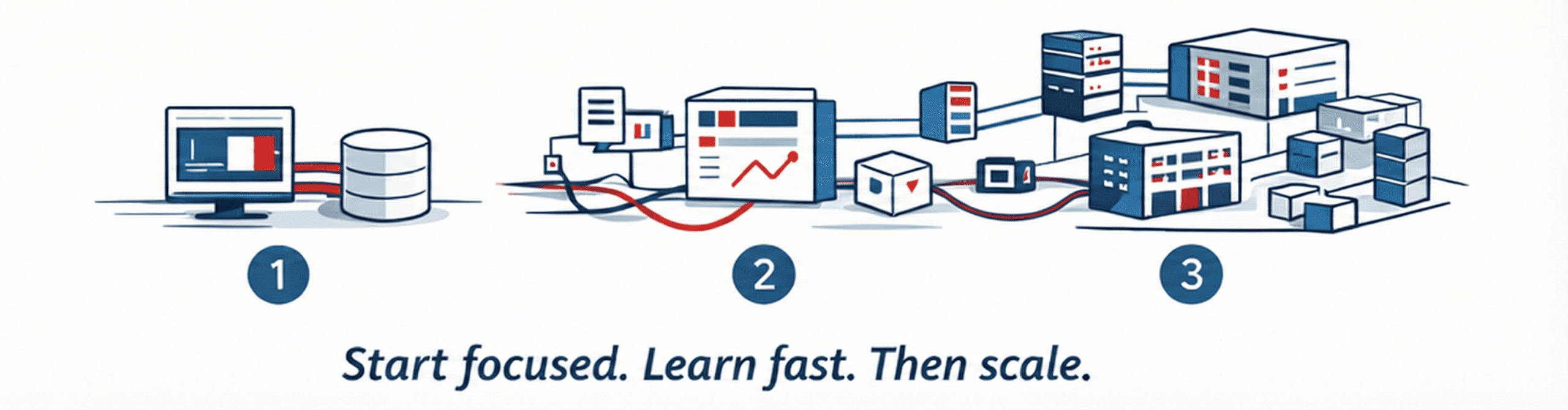
That approach almost always slows progress or leads to failure. The better approach is simple:
- Start with a few meaningful use cases.
- Get them working.
- Learn fast – and fail fast.
- Then expand.
Too often, companies pour resources into large platforms that don’t address their core challenges. We’ve stepped in after businesses invested $2 million in a new automation system—only to discover months later they still had to run the old platform alongside it because the new one couldn’t replicate key capabilities.
One last thought.
7. Governance and Standards Matter Most
Many teams build campaigns differently. Different naming conventions, logic structures, folder systems, and assumptions.
Everything works fine—until something breaks.
You’ll find yourself staring at a campaign named “Audience_Final_v3” trying to figure out what it actually does.
Consistent standards, naming, and design practices don’t feel exciting, but they’re what save you when the system is under pressure.
Deja vu? Or am I going nuts?
Across companies, platforms, and industries, I’ve seen the same pattern repeat:
- Data is messy.
- Projects are too ambitious.
- Tools are expected to solve people-problems.
- And governance gets ignored.
The organizations that succeed aren’t the ones with the flashiest stacks. They’re the ones that:
- Capture business intent so that they have clear, measurable success metrics
- Curate their data carefully
- Start with focused use cases
- Invest in skilled operators
- And build systems that are understandable, not just functional
In enterprise martech, the biggest risk isn’t usually the technology; it’s the complexity nobody took the time to manage.